NY invests $300M+ in Mid-Hudson psychiatric center once slated to close
The massive New Hampton project comes as officials point to a growing need for mental health treatment in New York’s criminal justice system.
More Stories


A massive construction project that has largely flown under the radar is transforming the Mid-Hudson Forensic Psychiatric Center in Orange County — just over a decade after New York planned to close the facility.
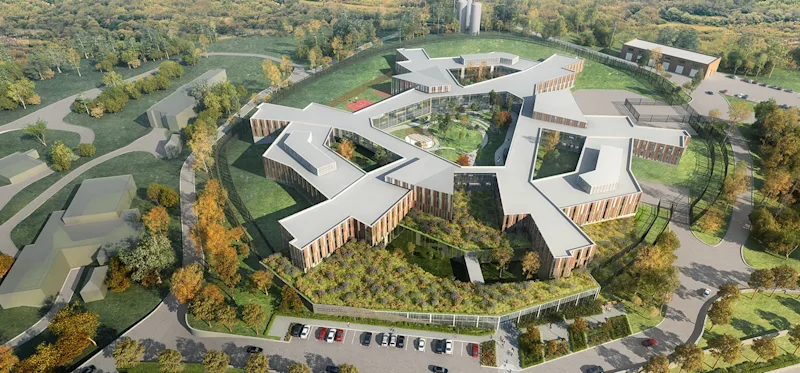
New buildings are rising at the campus at 2834 Route 17M in New Hampton, where the state is constructing a roughly 340,000-square-foot replacement forensic psychiatric hospital in an investment topping $300 million.
State Sen. James Skoufis says it marks a dramatic reversal from where Mid-Hudson stood about a decade ago.
“It’s a 180 that has happened over the last decade,” Skoufis said. “It’s a big deal. This is a massive, massive project that’s kind of flown under the radar here, but it’s an enormous development.”
The state proposed closing Mid-Hudson in 2013, a move Skoufis says would have eliminated more than 550 jobs and forced hundreds of patients to relocate elsewhere. Skoufis says he and former state Sen. John Bonacic spent roughly four years fighting the closure before the state reversed its decision in 2017.
Today, instead of being mothballed, the campus is the site of one of the region’s largest state investments in mental health infrastructure. Mid-Hudson is not a traditional psychiatric hospital. It is one of just three forensic psychiatric centers in New York serving people involved in the criminal justice system, including defendants deemed mentally unfit to stand trial.
Orange County District Attorney David Hoovler says the need for facilities capable of treating people with serious mental health issues has become increasingly apparent.
“There are people that need an institution or a facility for a period of time — or sometimes an extended period of time — to find their way back,” Hoovler said. “And I think we’ve lost track of that in today’s world.”
Hoovler says the issue is particularly visible in the criminal justice system, which he says was never designed to handle the number of people suffering from mental health and substance-use problems. He estimates that roughly 75% of people in Orange County’s criminal justice system have either a substance-use problem or a mental health issue — a number he says has increased over time.
“The criminal justice system was never built to handle people with mental health issues. It just wasn’t,” Hoovler said.
For Hoovler, treatment is also a public-safety issue.
“We want to be able to treat people, we want to be able to rehabilitate people with health issues that caused them to commit crimes and then get them back out in society so they don’t commit another crime,” he said.
The new secure hospital is being constructed on the existing Mid-Hudson campus and is expected to house hundreds of forensic psychiatric patients. Related water and sewer infrastructure work is also underway. Skoufis says the turnaround reflects a broader shift in Albany toward recognizing the need for more mental health services after decades in which psychiatric facilities and institutional beds were reduced.
“There has been, for sure, a shift in getting people in Albany to focus more on mental health and mental wellness,” Skoufis said.
Both Skoufis and Hoovler caution that a new hospital alone will not solve the state’s mental health challenges. Hoovler says the system needs a continuum of care so patients have somewhere to go and continued access to treatment after leaving an inpatient facility. He also points to shortages of psychiatrists, psychologists, social workers and other professionals who can help patients and families navigate the system.
Skoufis similarly says New York needs additional funding for community providers and a stronger continuum of inpatient and outpatient services.
“There’s always more to do, and I’ll be the first to say the state needs more,” Skoufis said. “But are we doing a better job than under the Cuomo years? There’s no question about it.”
What happens to the existing Mid-Hudson facility once the replacement hospital opens remains unclear. Skoufis says he does not yet know whether the older buildings will be demolished or repurposed.
The new hospital is expected to be completed in 2028.