How to spot the A3 comet before it disappears into the cosmos
We have until Oct. 26 to view it with the naked eye.


Next up on the list of unexpected things you’ll see in the night sky - a comet!
This is actually the brightest comet we've been able to see in the last 27 years. That comet was Hale Bopp back in 1997. This time, it's Comet Tsuchinshan C/2023 A3, or just A3 for short. It survived it’s trip around the sun last week after “photobombing” the CME on the coronagraph for a couple of days.
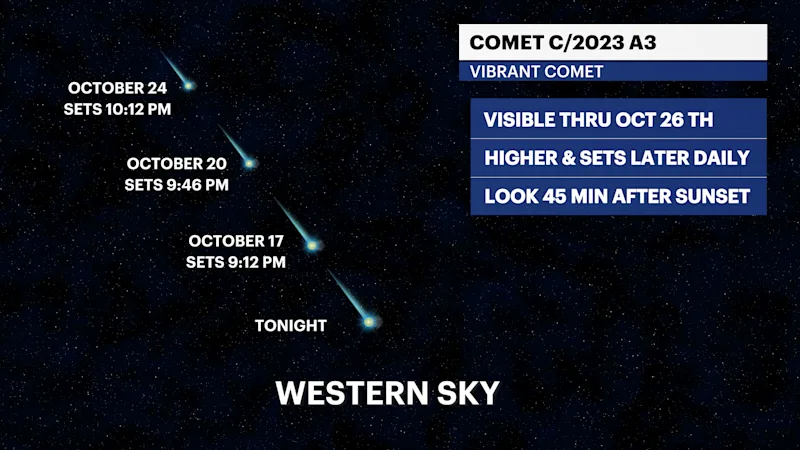
It emerged brighter than ever and it’s actually visible with the unaided eye this week in our western sky. The comet will be visible for at least two weeks before it gets too faint. Even now, it's hard to spot in brighter areas, so if you have binoculars, now is the time to use them. The best viewing conditions would be a dark wide open view of the western sky.
The comet is highest in the sky in the evening twilight and has been setting before 8:30 p.m. the last few nights. It will start to set a little later each night. Night by night, the comet will appear slightly higher in the sky than the night before.
On Wednesday night, it will set just before 9 p.m. The following night will be approximately 15 minutes later and this will continue through the week.
The comet, unfortunately, will also get dimmer because it’s traveling away from Earth. It’s closest approach was on Saturday, Oct. 12. We have until Oct. 26 to view it with the naked eye. By that point, it will only be about fifth magnitude, which is as bright as a faint star in the background. After that point, we will be able to follow it with a small telescope for about another month as it travels back toward the Oort Cloud.
The orbit of A3 is considered a long period comet, one that has over 200 years and could end up being hyperbolic. That means it may never visit the inner Solar System again. Experts say that this comet visited the inner Solar System 80,000 years ago.